

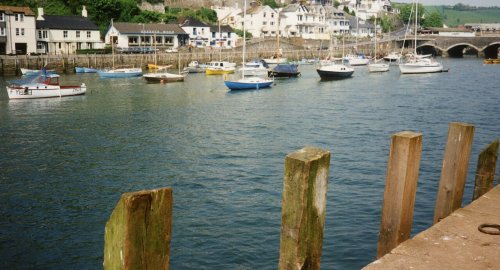
Two towns joined by a bridge
The town of Looe sits on the West and East side of the estuary and the Looe River sits between the two.
The estuary is a ria and was formed around 12,000 years ago.
An early wooden bridge over the Looe River was in place by 1411 this burned down and was replaced by the first stone bridge, completed in 1436 and featuring a chapel dedicated to St. Anne in the middle. Across the seven-arched Victorian bridge opened in 1853 lies West Looe and carries the A387 road,
The river dissects the landscape in and around Looe into deep wooded valleys, grassy hillsides and quiet stream filled gullies. Large tracts of ancient woodland remain on the river banks as you journey upstream and there are superb walks to be had in Kilminorth Woods which can be found at the end of the Millpool car park.
In 1824, a coastguard station was built, possibly to suppress smuggling operations in the area.
Duloe
Small village on high ground between East and West Looe Rivers about four miles South of Liskeard on the B3254, with circle of eight standing quartz stones, 38 foot in diameter, reputedly older than Stonehenge. The church of St. Cuby and St. Leonard has a massive 13th century tower which can be seen for miles around and the mighty tomb of Sir John Colshull of Tremadart (who, in 1450, was the second richest man in Cornwall). The holy well is half a mile away from the church towards Looe. The Plough Inn was once combined with a butchers shop.
Looe
East and West Looe joined by seven-arched bridge. Holiday resort of character, with several beaches, bustling quayside, unique Banjo Pier. Shark angling centre, two museums and St. Nicholas church. Nearby, Monkey Sanctuary, Mechanical music collection at St. Keyne, Lanreath folk and farm museum. Terminus of railway branch line from Liskeard. St. Georges or Looe Island lies just off the coast.
Millendreath
Located between Looe and Seaton at the end of a wooded valley filled with holiday chalets. Nearby is the Monkey Sanctuary.
Pelynt
North-west of Looe on the B3359. Known for Bishop Jonathan Trelawny of Trelawne Manor, which is now a holiday complex. The parish church is dedicated to St. Nonna. The Pelynt male choir regard Parson Hawker's song Trelawny as their own. Local pub is the Jubilee Inn.
Polperro
Showpiece harbour fishing village about four miles west of Looe, featured on many chocolate boxes. Tightly packed cottages tumble down to Fish Quay, on inner harbour, once packed with pilchard luggers. Many houses of interest, Couch's House (1595), House on Props, Old Watch House. The church of St. John was built in 1838. Coastal Cliff-path to bays and beaches. Severely flooded in 1976.
Seaton
The River Seaton winds through woods down to the sea at Seaton. A notorious smuggling area in the last century because it was wild and remote. Brandy, silk and spices were brought in from Brittany. Free parking and a beach cafe. East of Looe on the B3247 coast road. Local pub is The Smugglers Inn.
St. Martin-by-Looe
Tiny hamlet one mile North-east of Looe on the B3253, location of the parish church of St. Martin.
Sandplace
Two miles north of Looe on the A387. Terras Bridge crosses the Looe River. Has a station on the Looe Valley Railway Line.
Talland Bay
Between Looe and Polperro. Named after Saint Tallanus, a hermit who made his home there in the 5th century. The altar of the present-day church is situated on the site of the original Celtic altar. The church is also unusual in having a detached bell tower. There are several small beaches in Talland Bay, served by a small car park and cafe. In 1922 the French trawler 'Marguerite' went aground in Talland Bay, having lost her bearings in a South-westerly gale.
Widegates
On the A387 road North-west of Looe.
Looe Island
A gem of an island.
Looe Museum
History of a town.
Looe Valley Vineyard
Fine wines.
Seaton Valley Country Park
Pretty valley running down to the sea.
The Monkey Sanctuary
Meet a natural colony of woolly monkeys at Looe.
Looe Bridges Rivers Roads The Coastal Footpath