

Across the Tamar into Cornwall
Tamar Bridge Office, St. Budeaux, PL5 1LP
Tel: (01752) 361577
Email: enquires@tamarcrossings.org.uk
Web: www.tamarcrossings.org.uk
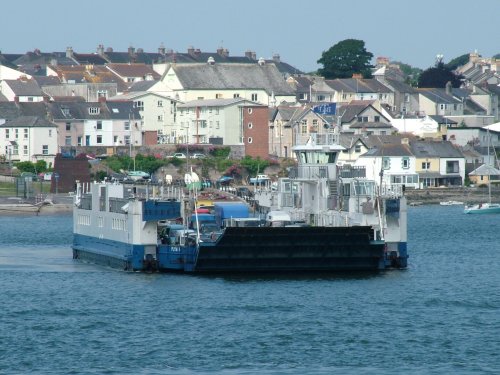
The Torpoint Ferry is a car and pedestrian chain ferry connecting the A374 which crosses the mouth of the River Tamar, between Devonport in Plymouth and Torpoint in Cornwall. The service was established in 1791 and chain ferry operations were introduced by James Meadows Rendel in 1832.
The route is currently served by three ferries, built by Ferguson Shipbuilders Ltd at Port Glasgow and named after three rivers in the area: Tamar II, Lynher II and Plym II. Each ferry carries 73 cars and operates using its own set of slipways and parallel chains, with a vehicle weight limit of 18 tonnes (20 tons). The ferry boats are propelled across the river by pulling themselves on the chains; the chains then sink to the bottom to allow shipping movements in the river. An intensive service is provided, with service frequencies ranging from every 10 minutes (three ferries in service) at peak times, to half-hourly (one ferry in service) at night. Services operate 24 hours a day, every day (including throughout Christmas and all other holiday periods), with service frequency never falling below half-hourly.
The ferry takes around 10 minutes as opposed to a 20-mile, 30-minute trip around the mainland.
The fully loaded weight of each ferry is given as 1,000 tonnes, powered by up to three 12-litre diesel engines with generators feeding the two electric motors each driving its chain-wheel of nearly 2m diameter. Normally one generator suffices; the extra two provide redundancy and extra power in bad weather or for extra speed. Each chain is 650m long and weighs 23 tons. There are eight guiding pulleys per chain and rubbing plates where the chains enter and leave the hull. The chains are replaced every three years.
Unlike most chain ferries with the chain ends attached directly to the shores, the chains of the Torpoint ferries are attached with a system of falling weights and pulleys on each shore and for each ferry. This keeps a minimum tension of three tonnes force on each chain, but also a maximum tension of this amount, plus some friction, as long as the weights are free to fall and rise in their pits.
A ferry route between Torpoint and Plymouth Dock (now called Devonport) was created by an act of Parliament, the Plymouth Dock to Torpoint Ferry Act 1790 and the Earl of Mount Edgcumbe began to run ferries the following year. In 1826 the ferry operations were taken over by the Torpoint Steamboat Company, which built landing piers on both sides of the Tamar. The company also built the steam ferry Jemima which entered service in 1831. The steamer was unable to hold a course in the strong tidal flow of the Hamoaze, so it was soon withdrawn and the older ferryboats returned to service.
The original ferries were replaced by two new ferries built in 1871 and 1878. As a result of increasing traffic, the ferry company investigated twin ferry operations in 1905. Both the Admiralty and Devonport Corporation opposed this as the company would need to expand the landing beach in Devonport. An experimental two ferry service with the existing shore installations had to be abandoned due to the strain on the equipment. A supplementary steamer service was also introduced in 1902, with the Volta and Lady Beatrice linking Torpoint to two locations in Devonport on a triangular route.
Cornwall County Council acquired both the ferry and the steamers in 1922 for £42,000. The Volta was immediately sold for breaking and two new ferries were ordered, which entered service in 1925 and 1926. These were the first ferries on the route designed to carry motor vehicles and could carry 800 passengers and 16 cars. Land was acquired on both sides of the rivers to lay a second set of chains and expand the landing beaches. A third, reserve, ferry was ordered and modern shore facilities were also built and twin-ferry operation began in July 1932. These changes made the supplementary steamer redundant and the Lady Beatrice was sold.
Motor traffic using the route increased rapidly after World War II, and two new ferries with a capacity of 30 cars each were introduced by 1961. A third ferry entered service in 1966 and a marshalling area was built on the Torpoint foreshore, relieving congestion in the centre of Torpoint. The landing beaches were expanded further in 1972, allowing all three ferries to operate simultaneously. The three ferries were refitted in the 1980's and were stretched so that they could carry approximately 50 cars. After the refit, they were named the Tamar, Lynher and Plym. These remained in service until 2005 when they were replaced by the current ferries.
Antony House Antony Woodland Garden Cawsand and Kingsand Millbrook Saltash
Mount Edgcumbe Country Park The Cornish Owl Centre The Tamar Valley Cornwall's Ferrys Tamara Way
The Rame Peninsula